Apple Inc.: Macro & Market Structure
Long-term equity structure using a 200-day smoothed moving average and drawdown framework.
This material is provided for informational and educational purposes only and does not constitute financial advice.
Analytical Framework
This study examines Apple Inc. through a long-horizon equity structure lens, using a 200-day smoothed moving average (SMMA) as a proxy for primary trend and prevailing risk conditions.
A 15% drawdown band beneath the moving average is included to contextualise historical pullbacks occurring within broader risk-on financial environments. The framework is descriptive and designed to assess regime persistence rather than short-term price behaviour.
Long-Term Price Structure
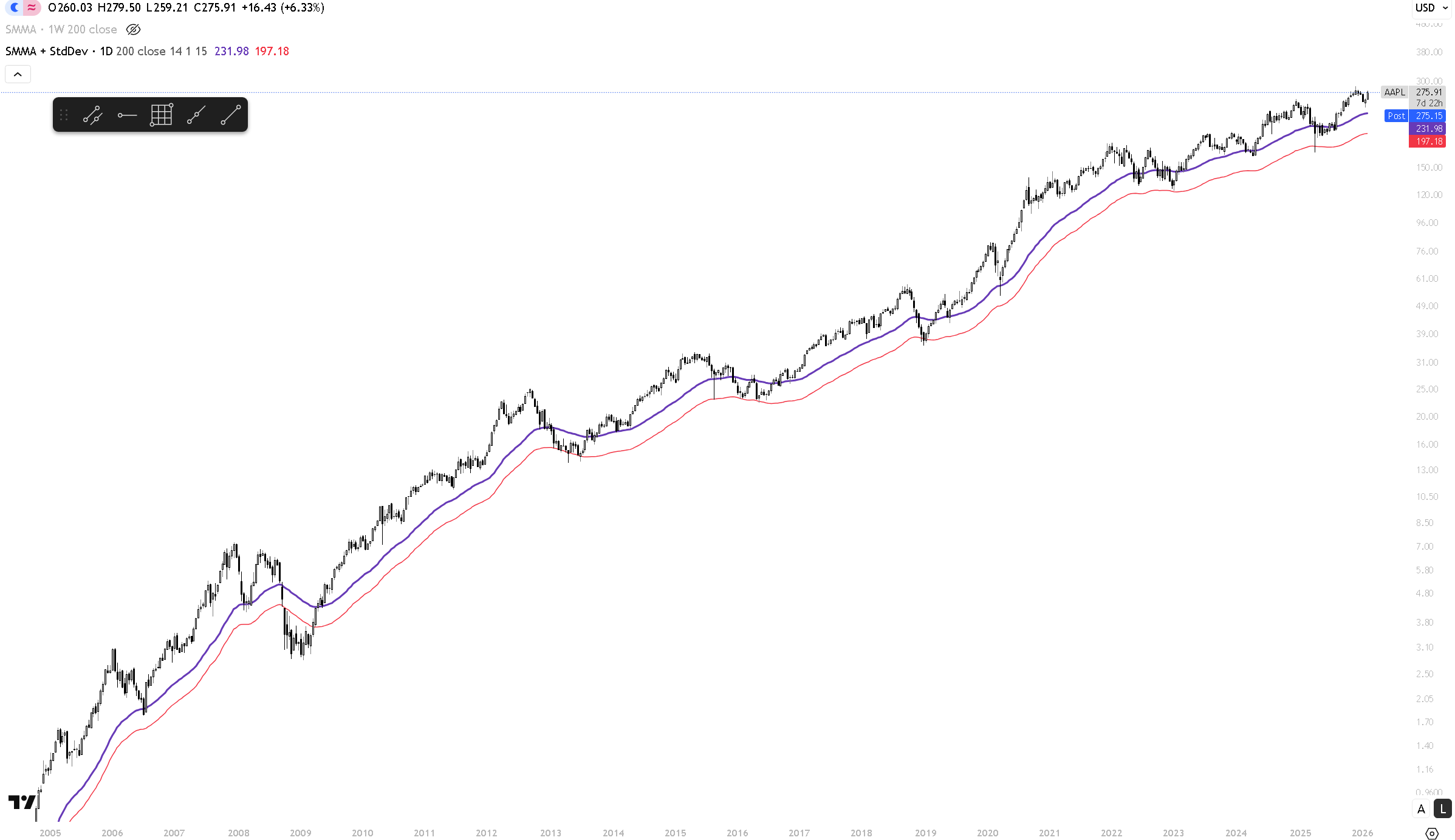
The chart illustrates Apple’s long-term price behaviour relative to its primary trend, highlighting recurring pullback zones during sustained equity expansions.
Structural Characteristics
- The 200-day SMMA functions as a long-term trend reference, smoothing cyclical volatility while remaining responsive to changes in equity market conditions.
- During extended risk-on regimes, price has tended to respect the moving average, with corrections typically contained within a defined drawdown range.
- Pullbacks approaching the 15% drawdown band have historically coincided with periods of sharp accumulation rather than structural trend failure.
- Sustained violations below this region have generally aligned with broader deterioration in equity risk appetite rather than idiosyncratic weakness.
Interpretation
From a macro perspective, Apple’s long-term structure reflects the behaviour of large-cap growth equities operating within supportive financial conditions. Trend persistence has historically been maintained through measured pullbacks rather than abrupt regime shifts.
The interaction between price and the 200-day SMMA and its 15% retracement band provides contextual information about the prevailing equity regime, while the drawdown band offers a reference for distinguishing corrective phases.
This framework is intended to support long-horizon market structure analysis, contributing to an understanding of equity behaviour within risk-on macro environments rather than informing tactical decisions.