Long-Term Price Structure
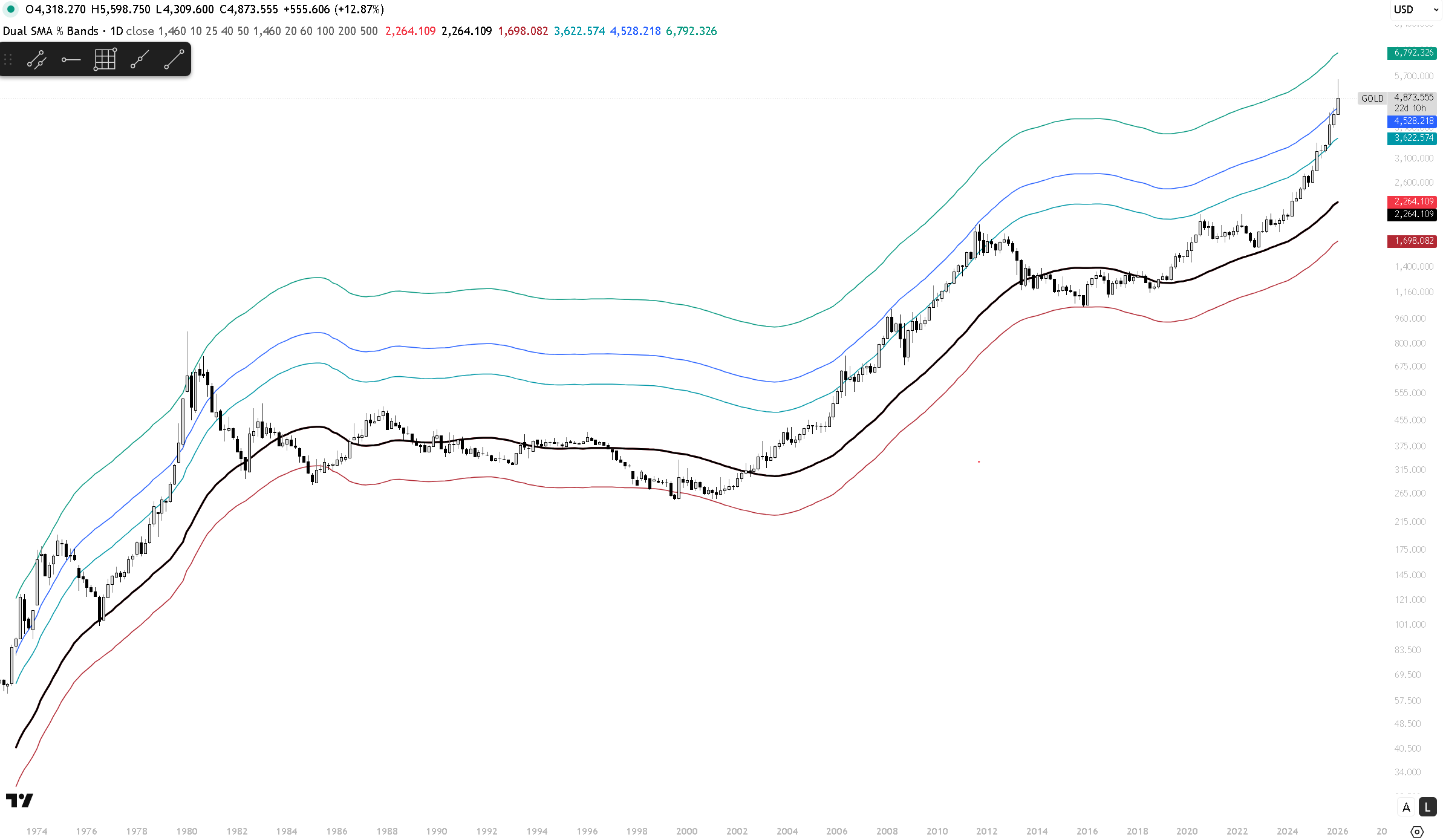
The chart illustrates gold’s historical tendency to oscillate around a stable long-term trend, with periods of expansion and contraction occurring within identifiable structural boundaries.
Long-term structural analysis using 1460-day moving average extension bands.
This material is provided for informational and educational purposes only and does not constitute financial advice.
This study examines gold through a long-duration market structure framework centred on a 1460-day moving average, approximating a full four-year cycle. The analysis is designed to contextualise price behaviour across secular regimes rather than to identify short-term trading opportunities.
Extension bands are constructed at 60%, 100%, and 200% above the moving average, alongside a 25% drawdown reference below trend. These bands are used as descriptive measures of historical price dispersion relative to long-term trend.
The chart illustrates gold’s historical tendency to oscillate around a stable long-term trend, with periods of expansion and contraction occurring within identifiable structural boundaries.
From a macro perspective, gold demonstrates recurring cycles of expansion and consolidation around a persistent long-term trend.
This framework is intended to provide structural context for long-horizon analysis, supporting assessment of regime conditions rather than short-term price forecasting.