An observational study of intraday price interaction with predefined structural levels.
This material is provided for informational and educational purposes only. It does not constitute financial advice.
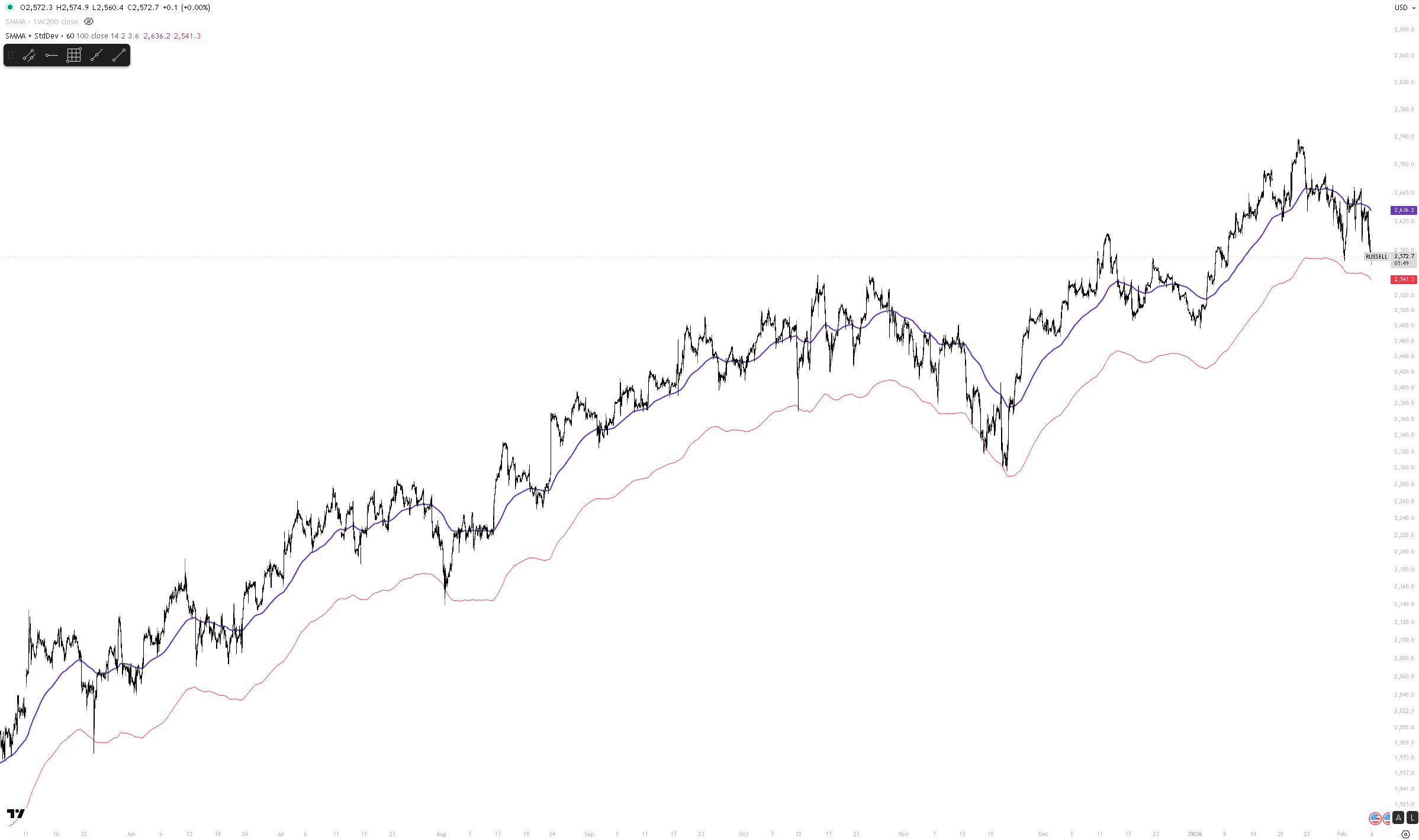
This observation examines recurring price behaviour in the Russell 2000 at predefined, measured levels on the hourly timeframe. These levels are defined by a 3.6% drawdown from the 100 hour moving average, a calculation methodology discovered to be followed by sharp V shape corrections within risk-on macro-economic conditions.
The objective of this study is not to infer intent, but to document how price frequently responds to areas where liquidity is structurally concentrated. Such behaviour is most visible during periods of institutional participation, where execution efficiency take precedence over directional reasoning.
The chart highlights how price frequently accelerates into this drawdown band, followed by sharp reactions, or temporary reversals. These responses are often misinterpreted as randomness when viewed without a structural framework.
From a market microstructure perspective, these behaviours align with how large participants interact with price. Institutions do not operate with directional urgency; instead, they require liquidity to enter, exit, or rebalance positions efficiently.
this measured level acts as reference zones where opposing flows are likely to exist. Price movement into these areas facilitates trade matching, often resulting in sharp but temporary dislocations that appear manipulative when viewed without context.
This framework does not suggest coordination or intent to deceive. Rather, it reflects the mechanical outcome of size, liquidity constraints, and execution requirements in financial markets involving large instiutional players.