Bitcoin: Long Term Structural Support Levels

A long-horizon case study examining regime-consistent accumulation zones in BTCUSD.

This material is provided for general informational and educational purposes only. It does not constitute financial advice or a recommendation.

Context

This case study examines Bitcoin through a structural, long-term lens. The objective is not trade timing or short-term forecasting, but the identification of price regions that have historically aligned with favourable long-horizon risk conditions during established secular trends.

Two independent reference frameworks are explored:

  • 1,400-day smoothed moving average (SMMA) as a proxy for regime anchoring.
  • Percentage deviation framework from the 365-day smoothed mean.

1,400-Day SMMA as Structural Support
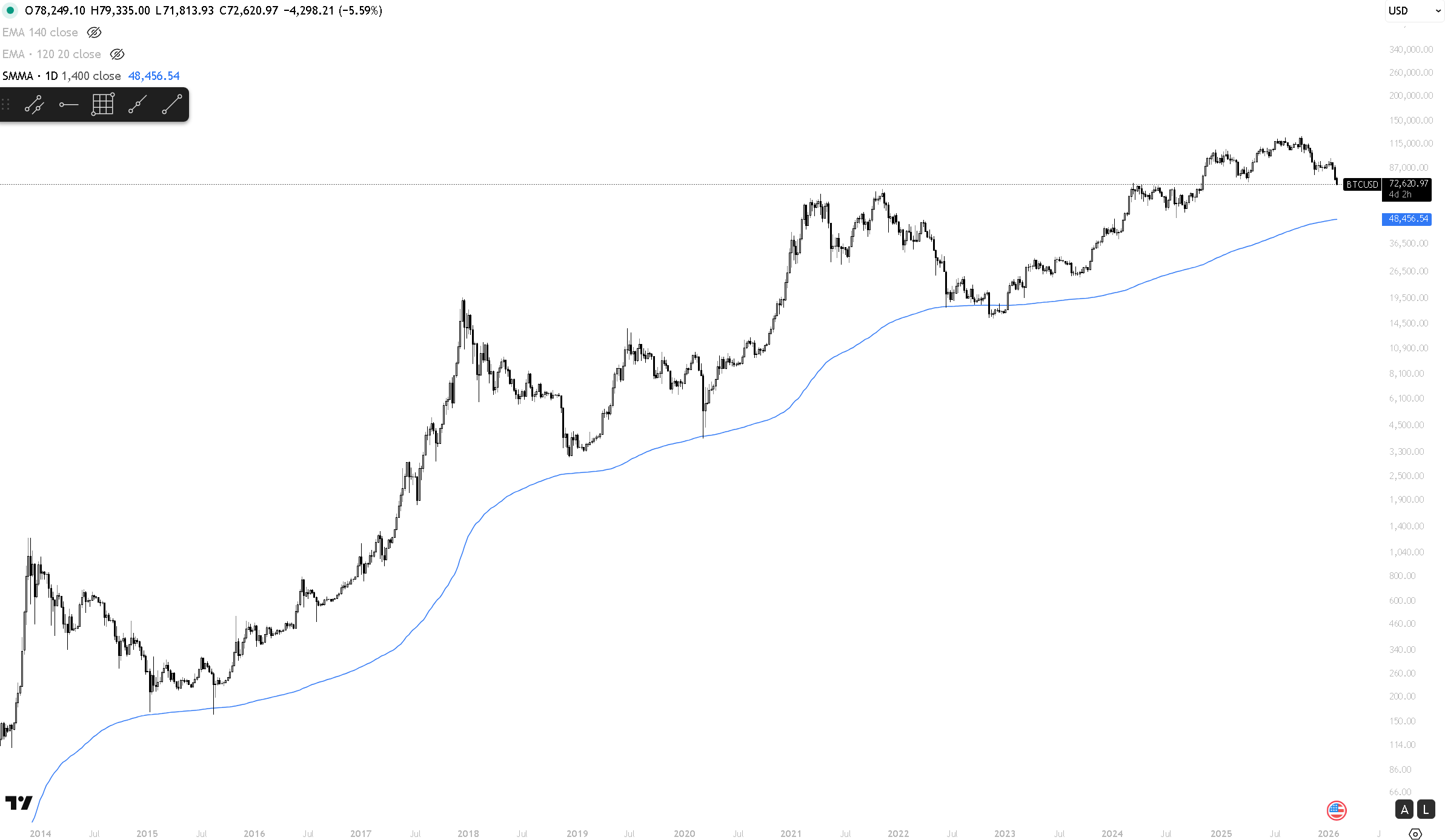
BTCUSD with 1400-day SMMA
1,400-day SMMA highlighting long-term regime support | BTCUSD TradingView

The 1,400-day SMMA provides a slow-moving reference point that filters volatility while remaining responsive to multi-year regime shifts.

  • Proximity historically aligns with compressed downside risk.
  • Extended deviations mark expansionary regimes.
  • Functions as an accumulation zone rather than precise support.
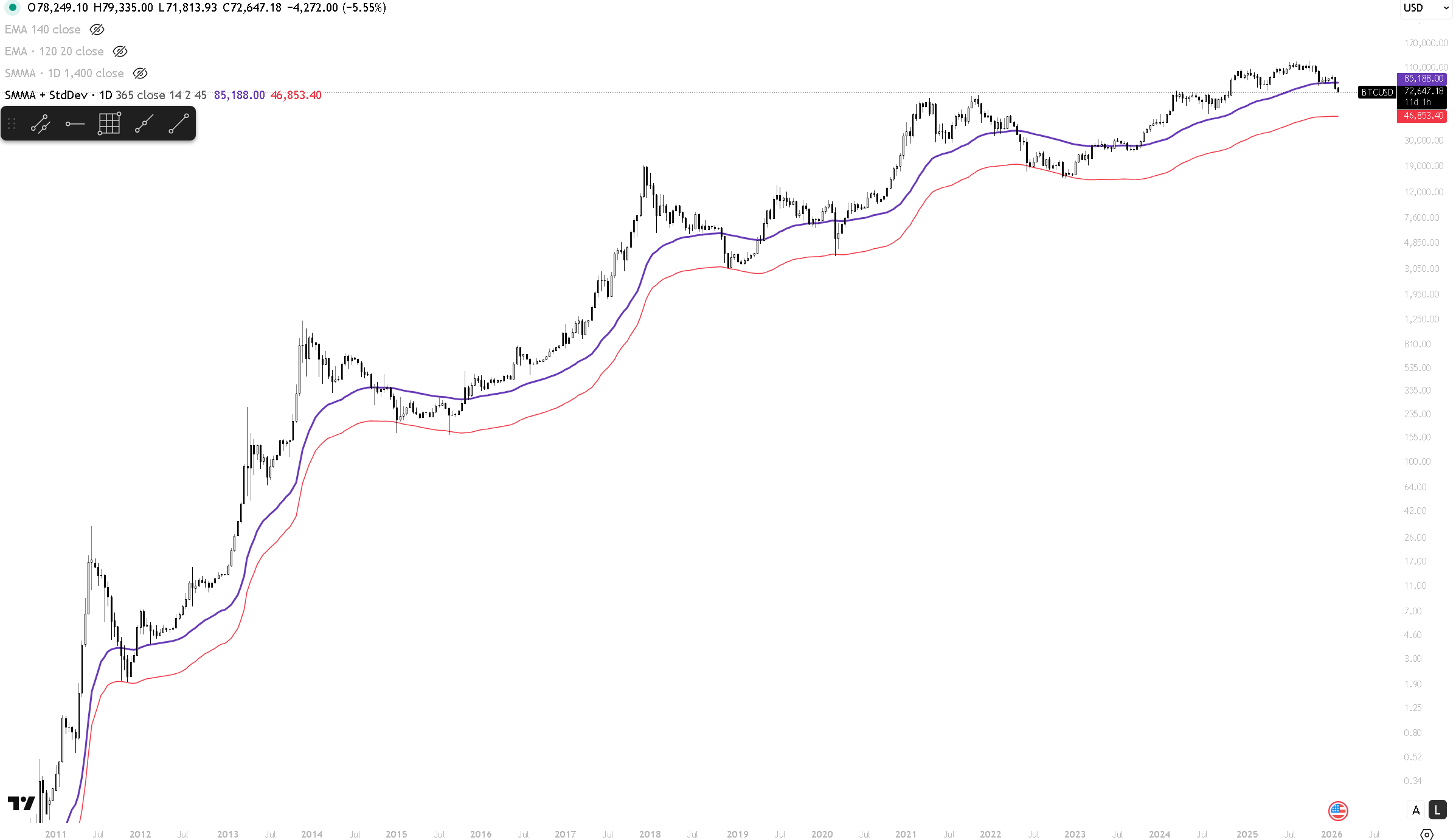
45% Retracement Band From the 365-Day Mean

BTCUSD deviation bands
45% deviation from the 365-day smoothed mean (Dan's source code) | BTCUSD TradingView

A drawdown of approximately 45% from the 365-day SMMA has historically marked zones of downside compression.

  • Occurs during macro and crypto-specific deleveraging.
  • Descriptive rather than predictive.
  • Confluence increases contextual validity.

Interpretation

These frameworks serve as structural context.

Convergence between deep deviations and long-horizon trend support has historically marked materially different long-term risk conditions.